Free · First edition
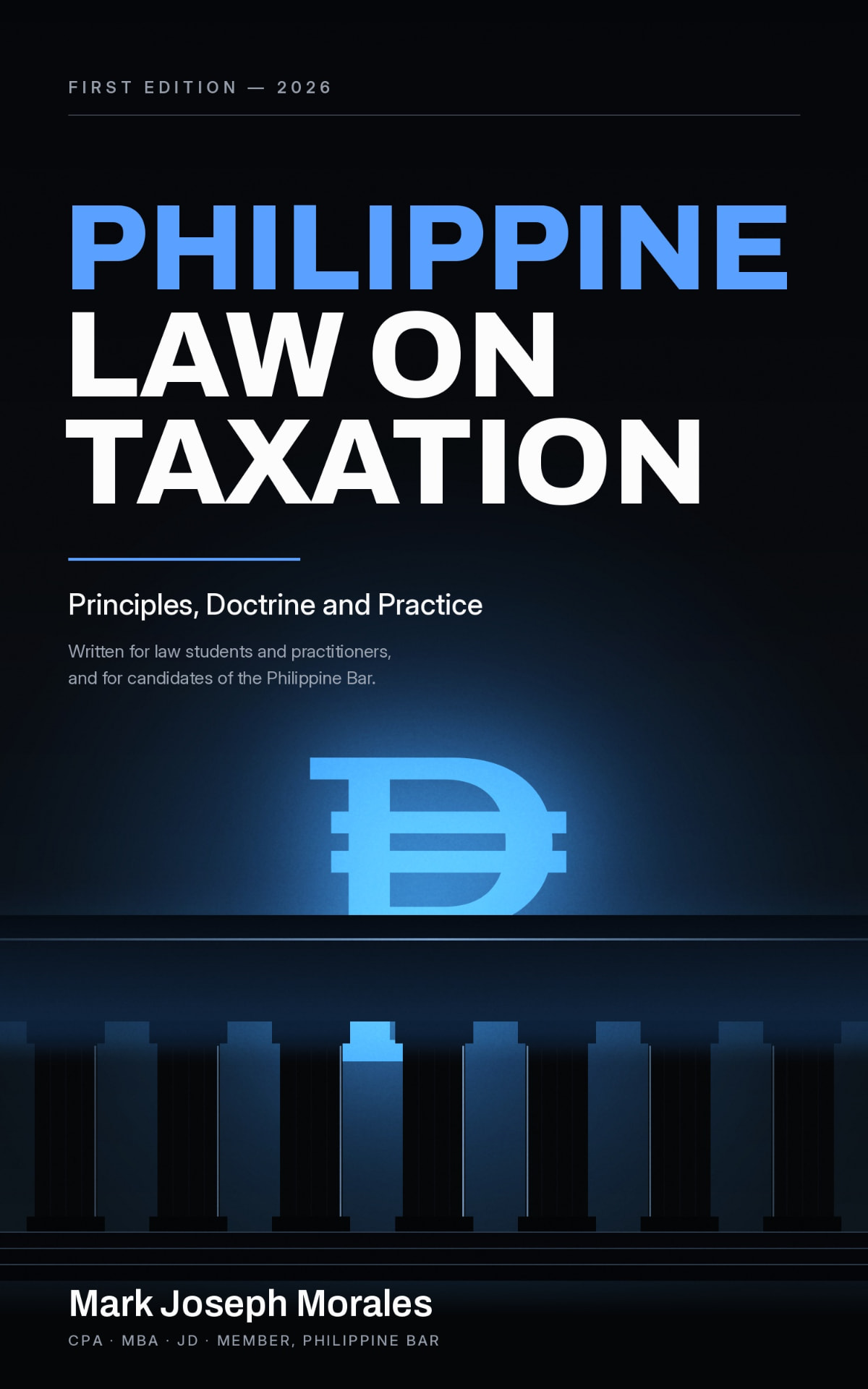
Philippine Law on Taxation
Principles, Doctrine and Practice
Seven parts. Thirty-two chapters. A complete treatment of Philippine taxation — from the constitutional basis of the power to tax, through to the Court of Tax Appeals.
First edition, 2026 · PDF and EPUB
Facts about the book
7
parts
32
chapters
2026
first edition
Free
in full
Who it is for
Law students
Doctrine set out in the order it is taught, with the leading cases in place.
Bar candidates
Worked problems and a method for answering a question under time.
Practitioners
The remedies and the timetables, as they actually run.
Inside the book
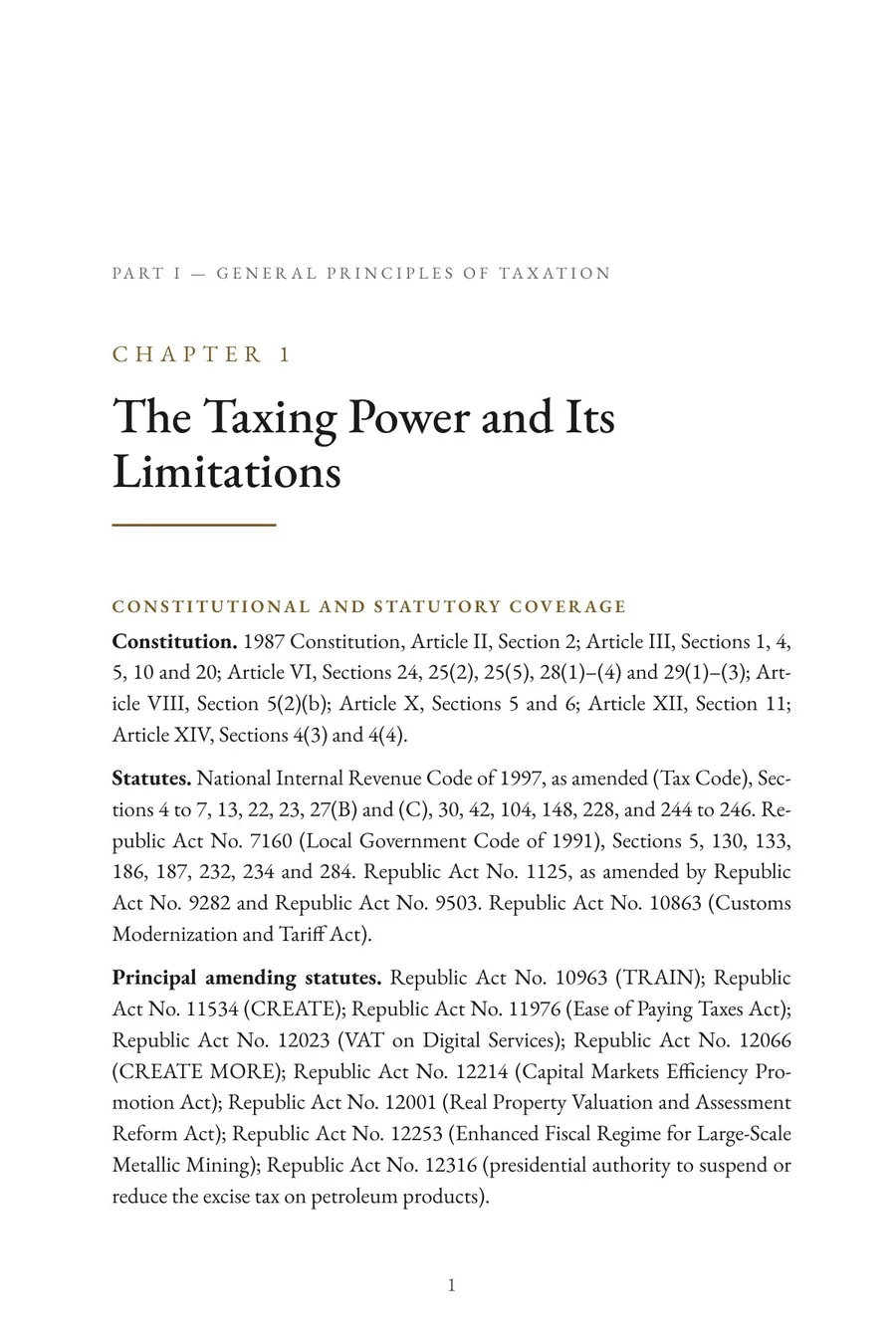
The book is built in seven parts. The first three establish the foundations — the nature of the taxing power, the inherent and constitutional limitations on it, and the doctrines that qualify it — before turning to the architecture of the income tax: what income is, when it becomes taxable, who is subject to it, and where it is taxed.
Parts three and four work through the tax itself. Compensation, business and professional income, deductions, individual and corporate taxation, passive income and final taxes, capital gains and property transactions; then withholding, value-added tax, percentage and excise taxes, and documentary stamp tax.
Part five takes up the transfer taxes and local taxation — estate tax, donor's tax, local business tax, and real property tax. Part six is given entirely to administration and remedies: the authority of the Bureau, assessment, collection, the taxpayer's administrative remedies, and the jurisdiction of the Court of Tax Appeals.
The seventh part is what distinguishes this book from an annotation. Chapter 29 sets out a method for solving any tax problem — a ladder of questions that sends the reader back through the earlier chapters. Chapter 30 covers tax law as it is actually practiced: planning, audit, assessment response, protest, refund, and litigation. Chapter 31 is a question bank organized by topic and graded across five levels, from identifying the rule to a multi-issue integrated problem. Chapter 32 closes with comprehensive problems in which the student must find every tax at work in a single transaction.
Each chapter follows the same structure: the basic idea before the black letter rule, a worked example before the statute, the leading cases in full treatment, boxes distinguishing the pairs that are commonly confused, the traps that recur in examination, and a summary the reader can revise from.
Contents
- IChapters 1–3
Foundations
The constitutional basis of the power to tax and its limits.
- IIChapters 4–9
The architecture of income taxation
Gross income, exclusions, deductions, and the tax base.
- IIIChapters 10–16
Individuals, entities, and property
Taxpayer classification and the treatment of property transactions.
- IVChapters 17–19
Withholding, VAT, and other national taxes
Collection at source and the national indirect taxes.
- VChapters 20–23
Transfer and local taxation
Estate and donor's taxes, local business and real property tax.
- VIChapters 24–28
Tax administration and remedies
Assessment, protest, refund, and the Court of Tax Appeals.
- VIIChapters 29–32
Integration
Worked problems drawing the whole system together.
The first edition is free
Read it before you buy anything.
The first edition is given away in full — not a sample, not a chapter. The second edition, revised to 2027 law, will be sold as an ebook. Readers who take the first edition are told first when the second is ready.
No spam. One email when the law changes.
For faculty
Teaching copies are free, as is everything else here. If you are considering the book for a course, write and say which subject and institution.